- Industry insights
- People in tech
- Product development
- Tech trends at BEECODED
- 29 Sep 2025
How Startups Can Leverage AI to Compete with Legacy SaaS Players
Startups can use AI in a more agile, personalized and quickly implementable way, allowing them to compete in certain market segments.



Table of contents
- Why AI Is the Startup’s Secret Weapon
- Key Advantages AI Brings to Early-Stage SaaS (speed, cost reduction, scalability)
- AI-Powered User Engagement: Retain Customers without Needing Enterprise-Level Budgets
- How to Add AI Features Without Huge Budgets
- Risks and Challenges for Startups Adopting AI
- Action Plan: 5 Steps for Integrating AI into Your SaaS Startup
- Summary: Competing with Legacy SaaS Is Possible with AI
Contributors


Launching a SaaS startup always comes with a dose of excitement, but also with a natural fear: how do you compete with the giants who already dominate the market? At first glance, the gap in resources and client portfolio can feel overwhelming. But competing with major companies only becomes paralyzing if we look at it from a negative angle. Once we shift perspective and focus on the real advantages startups have over legacy SaaS players, things take on a different light.
Even though the giants are also integrating AI, startups can use it in a more agile, personalized and quickly implementable way, allowing them to compete and even take the lead in certain market segments. Read on to find out how you can turn AI into a real competitive advantage, even when facing major companies that already leverage the technology.
Why AI Is the Startup’s Secret Weapon
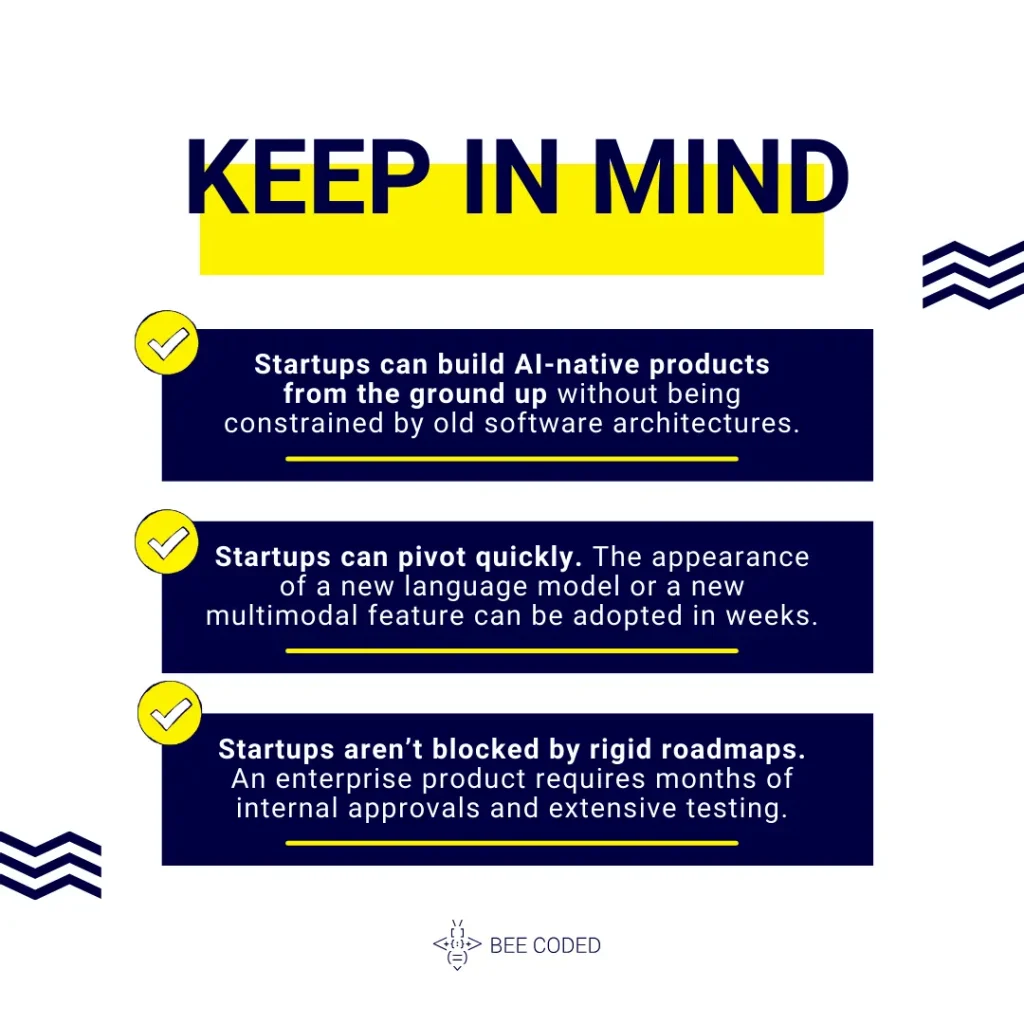
AI is no longer a privilege reserved for companies with huge budgets. According to a 2024 PwC report, over 70% of startups are already using AI to make better decisions and work more efficiently (medium.com). However, the difference is that for the major SaaS platforms, AI is often an added layer on top of an existing architecture built years ago. Startups, on the other hand, have the unique opportunity to create AI-native products from scratch, with workflows designed to be automated and optimized.
In other words, the real advantage isn’t AI itself, but the speed and flexibility with which startups can integrate and leverage it.
Key Advantages AI Brings to Early-Stage SaaS (speed, cost reduction, scalability)
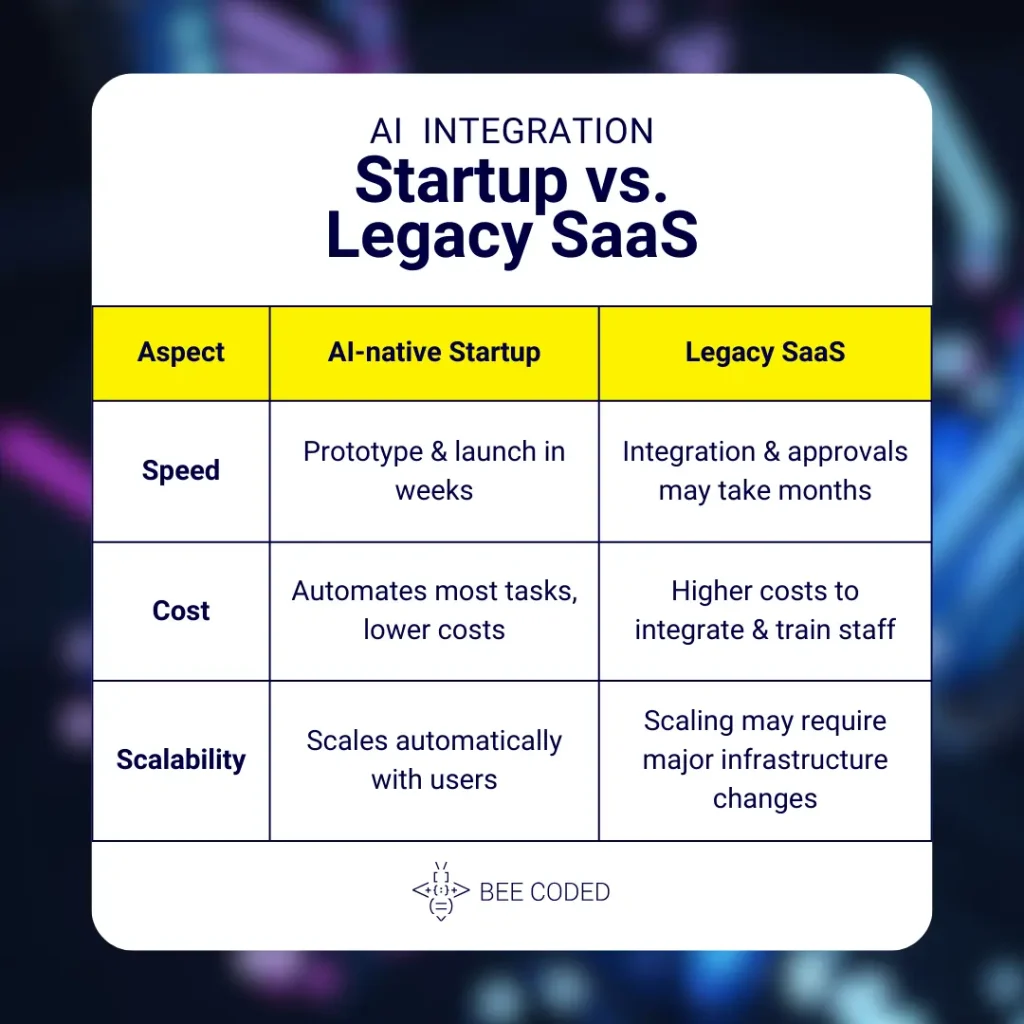
AI offers three major benefits for startups at the beginning of their journey: speed, cost reduction, and scalability.
Speed
AI can accelerate feature development and product optimization.
- Startup: an AI feature prototype can be tested and launched within weeks using APIs or open-source models.
- Legacy SaaS: implementing the same features may take months due to the need to integrate AI into an existing architecture and pass through multiple internal approval stages.
Cost reduction
AI enables the automation of repetitive tasks, reducing the need for additional human resources.
- Startup: an AI chatbot can handle around 80% of user queries without hiring a support team.
- Legacy SaaS: achieving the same requires modifying existing processes, training employees, and ensuring compatibility with already complex systems, which naturally increases costs.
Scalability
AI-native products are designed to grow with the user base without costly restructurings.
- Startup: can automatically scale the AI engine for 100 or 100,000 users.
- Legacy SaaS: scaling often requires massive resources, database restructuring and infrastructure reconfiguration.
AI-Powered User Engagement: Retain Customers without Needing Enterprise-Level Budgets
One of the biggest challenges for startups is retaining users, not just attracting them. SaaS giants have data science teams and complex CRMs that personalize each customer’s experience. Startups can’t afford such investments, but AI can make one-to-one personalization more accessible. An AI engine can analyze each user’s behavior and adjust the interface, recommendations and notifications. Legacy SaaS can do the same, but at much higher costs and longer implementation times.
How to Add AI Features Without Huge Budgets
When you’re just starting out, budgets are tight. Luckily, you can still integrate AI in many cost-effective ways.
- Accessible APIs: provide access to high-performance models on a pay-as-you-go basis without high upfront costs.
- Open-source models: the AI community offers ready-to-use models that can run on standard servers.
- Plug-and-play platforms: SaaS solutions exist to quickly add chatbots or recommendation engines.
Startups can launch AI features quickly. Legacy players, on the other hand, must make bigger investments and the process takes longer.
Risks and Challenges for Startups Adopting AI
Adopting AI comes with challenges, both for startups and giants.
Common risks for startups and legacy players
- Unpredictable API costs (if usage spikes)
- Data privacy concerns
- Accuracy limitations (AI can make mistakes)
For startups, these risks are usually smaller because scaling is gradual and adjustments can be made quickly. Legacy SaaS, with millions of customers, has much more to lose in a data breach or AI error.
Startup-specific risks
- Over-reliance on an external provider
- Small teams may lack AI expertise, leading to superficial implementations.
How to mitigate them:
- Use open-source solutions as a backup.
Start with small MVPs tested on limited user segments
Action Plan: 5 Steps for Integrating AI into Your SaaS Startup
Let’s get practical. Here’s a simple plan for integrating AI:
- Identify – pinpoint key areas for automation. Start with manual, time-consuming tasks like support, onboarding, or data analysis. For example, use a tool that generates reports automatically instead of paying an analyst.
Learn more about automated document generation here.
- Prototype – quickly build a prototype using an API or open-source model (a chatbot for FAQs, for instance).
- Validate – test with a small user group and gather feedback. For example, check if the chatbot solves at least 70% of queries before launching globally.
- Scale – expand functionality and optimize costs. For example, you can move from a commercial API to a self-hosted open-source model.
- Monitor – track performance and adjust continuously (add filters to prevent incorrect responses, for instance).
Additional tips:
- Use AI-driven analytics for smarter decisions. AI can help forecast trends.
- Enhance customer engagement with chatbots and personalized recommendations
- Leverage AI for marketing & sales growth
- Invest in scalable AI solutions: no-code platforms for quick integration without heavy IT investment.
Summary: Competing with Legacy SaaS Is Possible with AI
Competing with the giants is less about AI and more about how you use it. With a smart strategy and the courage to experiment, startups can successfully compete with the biggest SaaS players.
Thinking about launching a SaaS app? Let’s connect! Contact us and let’s integrate AI from day one. Check out our AI-powered SaaS development services.