- Industry insights
- People in tech
- Tech trends at BEECODED
- 17 Nov 2025
The Future of SaaS Security: How AI Automation Enhances Compliance and Threat Detection
Read on to discover how AI compliance automation, AI threat detection and automated risk monitoring.
Table of contents
- The Growing Need for Security in SaaS Platforms
- What Is AI-Powered Security Automation?
- How Does AI Security Automation Work?
- How AI Automation Enhances SaaS Security
- Compliance Automation and Audit Readiness
- Tools and Frameworks Powering AI SaaS Security
- BEE CODED’s Framework for AI-Driven Security Automation
- The Future of AI in SaaS Security
- FAQ: AI in SaaS Security
Contributors


In the AI era, opportunities to exploit systems are easier than ever. Therefore, SaaS companies must use artificial intelligence to their advantage, preventing incidents before they occur. Moreover, by the end of 2025, it’s expected that 85% of all business applications will be SaaS-based (according to unifycx.com).
So, as SaaS becomes the backbone of global infrastructure, it also becomes the main target for attacks. In security, it’s more important to prevent an attack than to react to it after it happens, and AI SaaS security helps us do exactly that: identify, automate, and remediate risks before they turn into incidents.
Read on to discover how AI compliance automation, AI threat detection and automated risk monitoring combine into an ecosystem that helps organizations stay resilient, compliant and competitive.
The Growing Need for Security in SaaS Platforms
The adoption of SaaS models has exploded in recent years, which means the volume of sensitive data handled by these platforms is growing rapidly (and so are the associated risks).
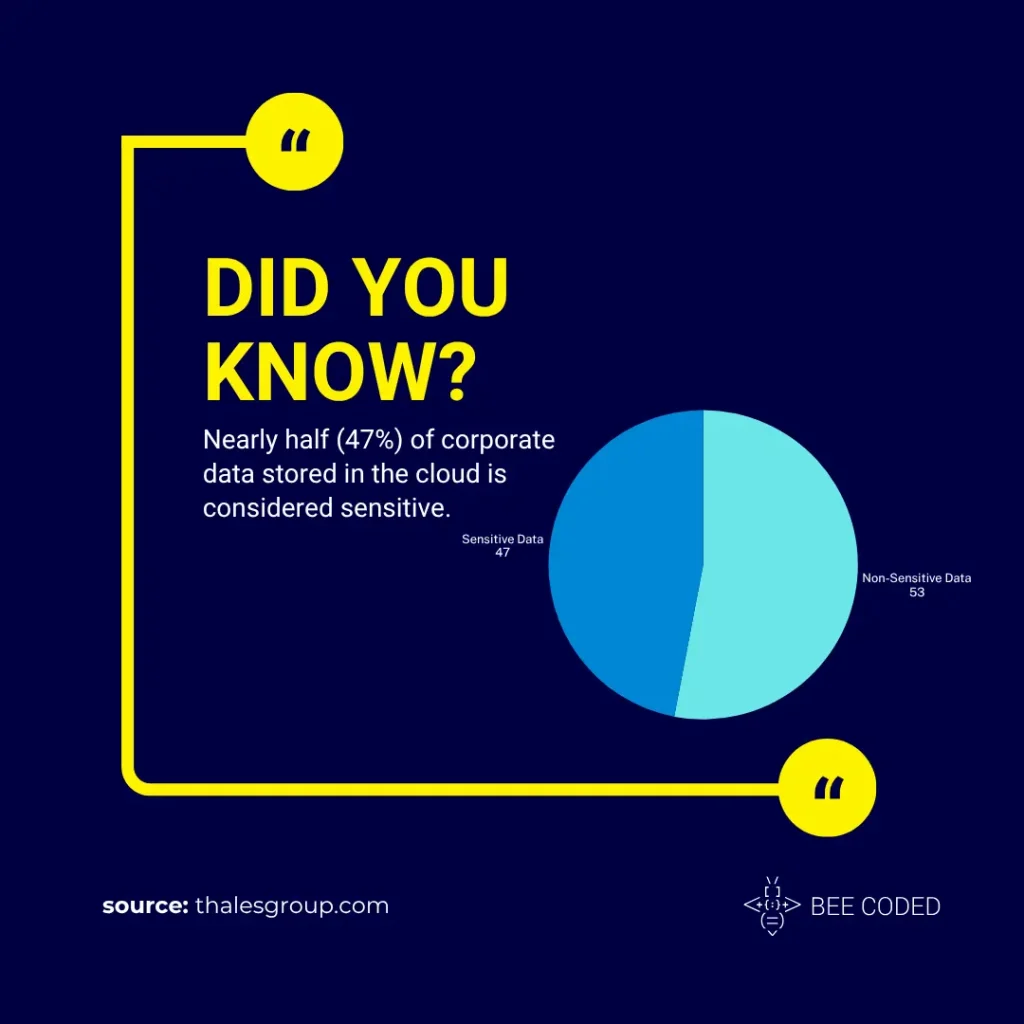
For example, a study by Thales Group shows that 47% of corporate data stored in the cloud is considered sensitive. And if a SaaS environment hosts critical information such as customer data, payment cards, or login credentials, then every additional SaaS application becomes a potential entry point.
In short:
more SaaS apps = more sensitive data = more exposure.
There are several types of cyberattacks, such as ransomware (malware that encrypts data and demands ransom) or data leaks (when sensitive information is exfiltrated from the system without authorization). And there’s also the compliance breach (when SaaS applications fail to meet regulations, e.g., GDPR), putting the organization at risk of penalties and damaging its reputation.
According to BullWall’s report, 57% of organizations have experienced at least one ransomware attack in the past two years. In this context, it’s clear that a purely reactive approach is no longer sustainable. We now need a proactive one, based on automated risk monitoring.
What Is AI-Powered Security Automation?
“AI security automation”, in simple terms, refers to automating security processes using artificial intelligence (for example, machine learning and natural language processing) to collect data, detect anomalies, and generate alerts.
Thus, when we talk about AI automation for SaaS security, we mean a SaaS platform that uses predefined rules, learns as it runs, and identifies unusual behaviors.
How Does AI Security Automation Work?
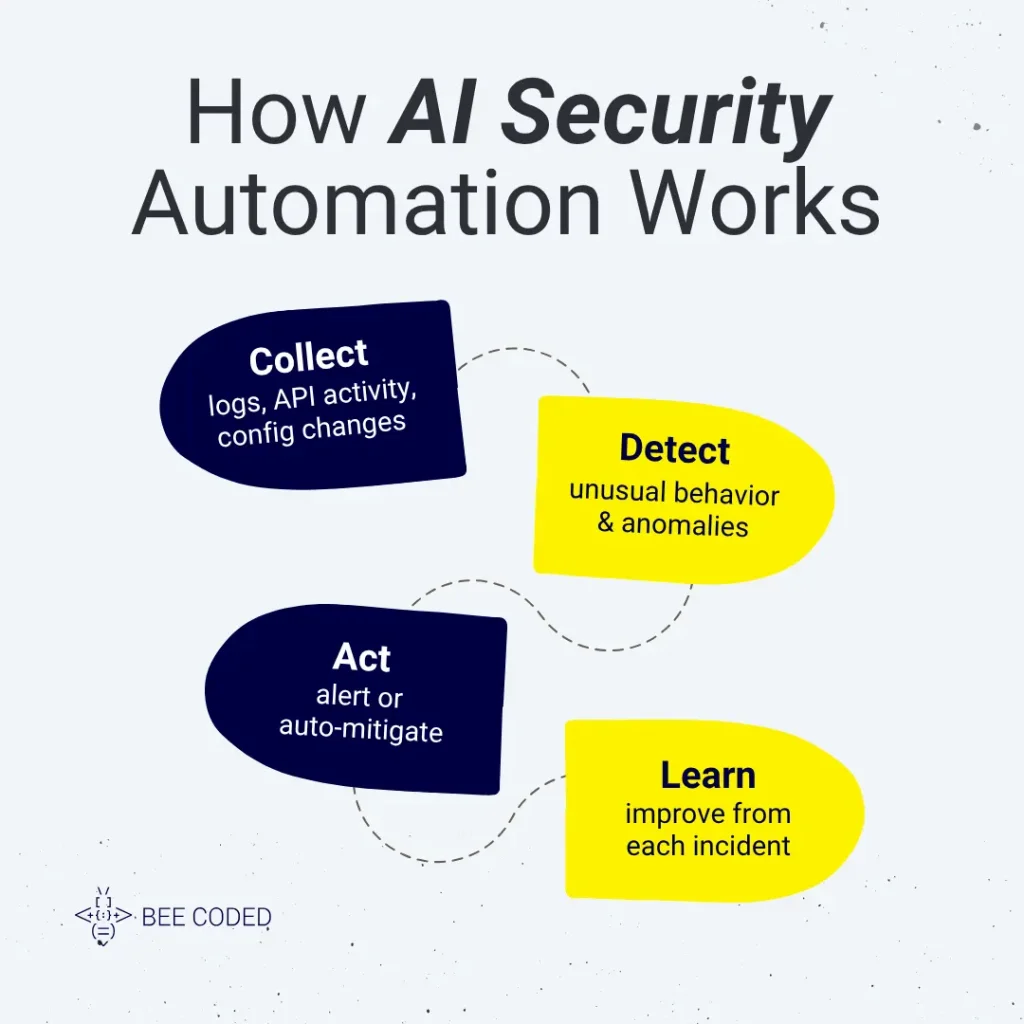
- Collect data: large volumes of data are gathered (event logs, access logs, API interactions, configuration changes). The ML model learns what “normal” looks like for the organization’s SaaS environment.
- Detect anomalies via AI: when an unusual behavior occurs (for instance, an account accessing an abnormal amount of data or an API sending information to an unfamiliar location), AI detects it.
- Alert or auto-mitigate: the system can either generate an alert or take automatic action (e.g., revoke access, block the account).
- Learn from incidents: the system learns from every event through a feedback loop and continuously improves its accuracy.
How AI Automation Enhances SaaS Security
AI SaaS security technologies bring tangible benefits across multiple layers:
Real-Time and Predictive Threat Detection
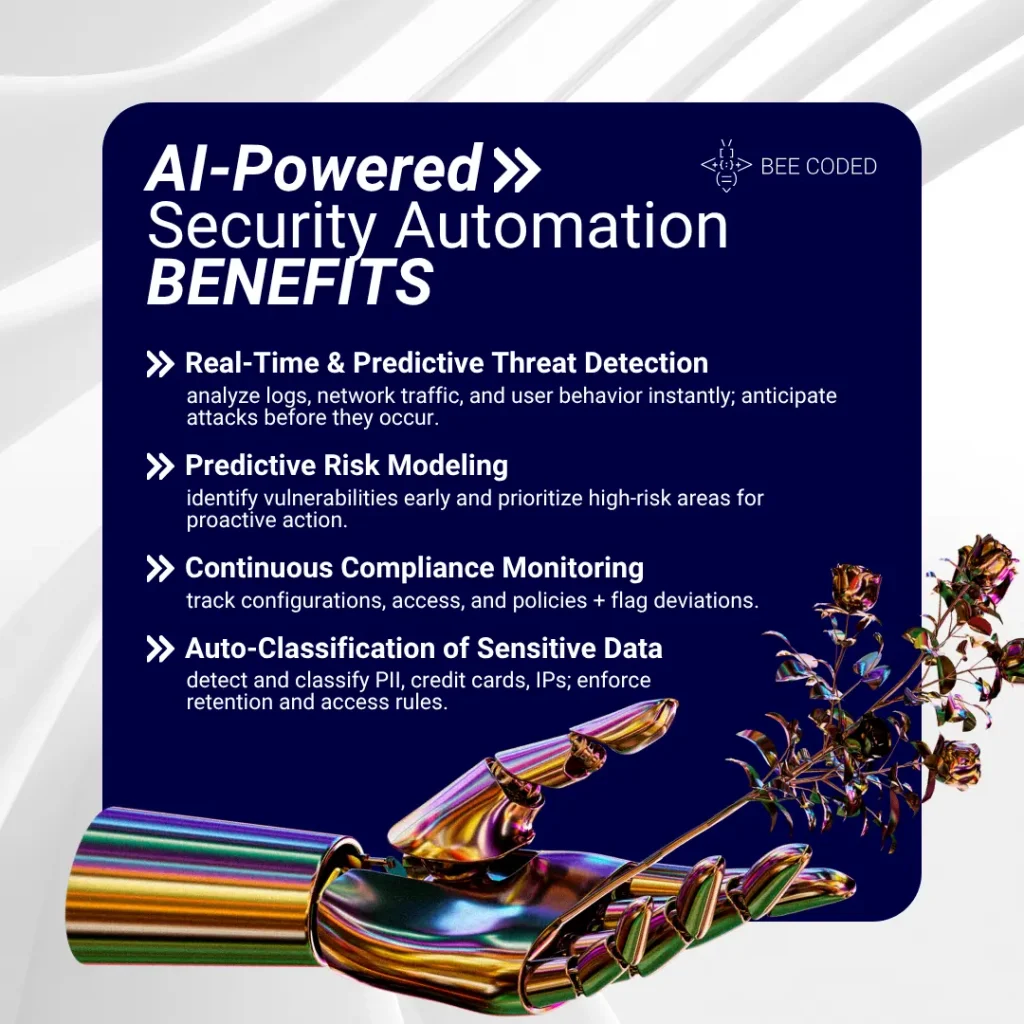
Thanks to its ability to process massive amounts of data within milliseconds, AI can analyze terabytes of logs, network traffic, and user behavior in real time, something that would be impossible to do manually. Moreover, predictive components allow attacks to be anticipated before they occur.
Predictive Risk Modeling
Through predictive analysis, the AI system can identify vulnerabilities before attackers can exploit them. For example, the model detects that a SaaS app has an outdated module, a high-privilege user, and recent external access logs—all of which together create a high-risk score. This allows for proactive intervention.
Continuous Compliance Monitoring
AI continuously monitors configurations, access permissions, retention policies, and more (all part of AI compliance automation). For instance, it can verify if multi-factor authentication (MFA) is enabled for EU users (a GDPR/SOC 2 requirement) and instantly flag any deviations.
Auto-Classification of Sensitive Data
AI scans newly uploaded files in the SaaS environment and automatically classifies them by content type (e.g., PII, credit cards, IP addresses). It can then automatically apply data retention policies, enforce minimal access rules and handle all aspects of SaaS workflow security.
AI-Driven Patching & Updates (Prioritization)
The AI model understands which vulnerabilities are exploitable in the company’s specific SaaS environment and which have the most impact, thus allowing proper prioritization. As a result, teams can allocate resources strategically where they matter most.
All these capabilities enable SaaS companies to strengthen their security posture without relying solely on human intervention. Learn more from our article about advanced strategies to prevent data breaches in SaaS Apps.
Compliance Automation and Audit Readiness
We’ve all heard of regulations like GDPR, ISO 27001, or SOC 2. These are becoming increasingly strict, so it’s very important to ensure compliance. The safest way to do this today is through AI automation.
Automated Compliance Checks
AI systems correlate the company’s internal policies with external requirements (e.g., GDPR, ISO 27001, SOC 2). For example, AI can automatically verify whether all EU users have multi-factor authentication (MFA) enabled (which is a common GDPR/SOC 2 requirement).
Automatic Detection of Non-Compliance (Compliance Drift)
A “compliance drift” occurs when a configuration deviates from the rule (for instance, when a developer disables MFA for a service). AI instantly detects the deviation and can automatically generate a remediation ticket or revert to the correct setting.
Report Generation (Audit Readiness)
For external auditors or internal reports, AI can instantly generate the required evidence, such as “proof that PII access was monitored over the last 90 days” or “a list of high-privilege users.” This ensures the organization is audit-ready without wasting time on manual preparation.
Tools and Frameworks Powering AI SaaS Security
To fully understand how solutions integrate, here’s an overview of major platforms and their roles:
Integrated AI/ML Security Platforms
- IBM QRadar: SIEM/analytics platform using ML to correlate logs and detect incidents.
- Palo Alto Cortex: XDR/SOAR platform interacting with multiple data sources and responding to threats.
- SentinelOne: endpoint security with autonomous detection and response capabilities.
- Darktrace: behavior-focused solution detecting network and application anomalies through ML.
These provide strong building blocks: ML engines, alert integration and automated response mechanisms. However, SaaS environments are highly diverse, and a single tool rarely covers all scenarios.
Why You Need an Integrator Like BEE CODED
As we have said before, SaaS environments vary greatly, so:
- you need API glue code for interoperability between tools (to extract logs from Salesforce, Zendesk, AWS, Azure, etc.)
- you need custom ML models, because a client’s SaaS logs have unique patterns, and generic models may not suffice.
- you need SOAR playbooks tailored to your ecosystem, defining what should happen when a non-compliance is detected (automatic blocking, alerting a risk manager, generating an audit log, etc.).
BEE CODED’s Framework for AI-Driven Security Automation
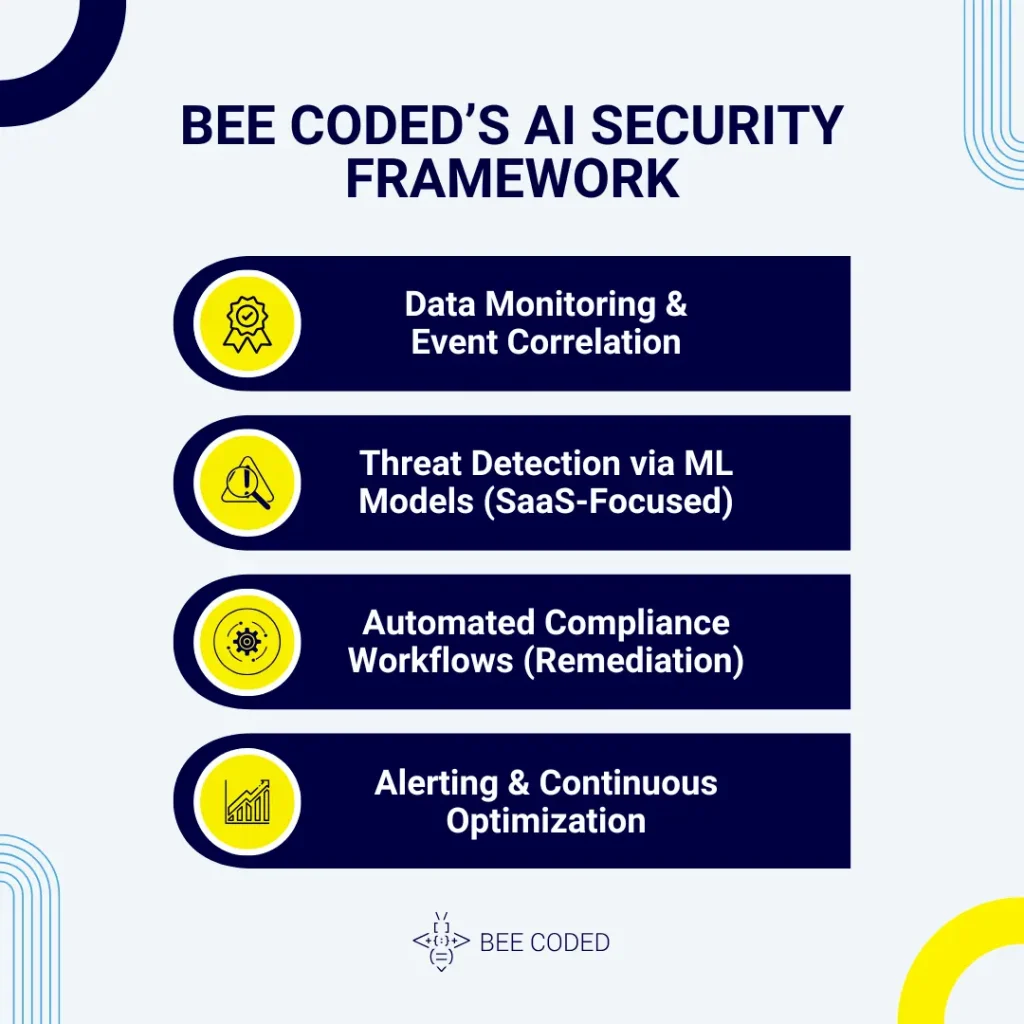
Data Monitoring & Event Correlation
We collect data from all sources (SaaS applications, cloud platforms, internal APIs) and normalize it into a single database. This eliminates data silos and ensures full visibility.
Threat Detection via ML Models (SaaS-Focused)
Our ML models are calibrated for threats specific to SaaS environments, such as: insider threats (employees stealing data), access misuse (compromised accounts), cloud misconfiguration, ransomware etc.
Automated Compliance Workflows (Remediation)
If the system detects non-compliance (for example, a user without MFA in an EU region), the system both alerts and automatically triggers a remediation workflow: re-enabling MFA, notifying management, and generating an audit report.
Alerting & Continuous Optimization
Alerts are intelligently filtered to prevent overwhelming teams with false positives. Moreover, each resolved incident serves as feedback to improve model accuracy over time.
The Future of AI in SaaS Security
Looking ahead to 2026–2030, we can expect AI copilots for security teams. In the near future, your team will collaborate with intelligent virtual assistants that suggest intervention steps and support the security team’s decision-making.
Applications Across Industries
- Finance: extended protection for banking data, transactions, and regulatory compliance.
- Healthcare: safeguarding patient data, ensuring HIPAA/GDPR compliance, and automating security audits.
- Retail: monitoring payments and detecting fraudulent customer account access.
- Manufacturing: securing connected OT/IT infrastructure and preventing supply chain ransomware.
If you’re a SaaS founder, take advantage of what AI brings to security. Applying advanced protection strategies for data breaches in SaaS is crucial, as such incidents can severely impact your business (both financially and in terms of customer trust and brand reputation).
Strengthen your SaaS with AI-driven security today. Contact us for compliance automation and intelligent threat detection. Discover more about our:
FAQ: AI in SaaS Security
- How does AI improve SaaS security?
AI improves SaaS security by analyzing large volumes of logs, user behavior, and network activity in real time. It detects anomalies, predicts risks, and automates threat response, helping prevent data breaches before they happen. This approach strengthens overall AI SaaS security and reduces manual workload.
- What is AI compliance automation?
AI compliance automation refers to using machine learning and automated workflows to monitor configurations, access permissions, and security policies. It continuously checks alignment with standards such as GDPR, ISO 27001, and SOC 2, instantly flagging compliance drift and generating audit-ready reports.
- How does AI help detect security threats?
AI detects security threats by learning what “normal” activity looks like in a SaaS environment and identifying deviations (such as unusual logins, suspicious API calls, or unauthorized data access). This enables AI threat detection in real time and supports automated risk mitigation.
- What are the best AI tools for SaaS security?
Some of the most effective tools for AI SaaS security include IBM QRadar (SIEM), Palo Alto Cortex (XDR/SOAR), SentinelOne (endpoint protection), and Darktrace (behavior-based detection). These platforms use ML models, automated alerts, and threat analytics to secure SaaS infrastructures.
How can BEE CODED help automate SaaS security and compliance?
Our BEE CODED team connects your SaaS apps, builds custom ML models, and automates compliance checks and threat mitigation through AI-driven workflows.