- Industry insights
- People in tech
- Product development
- Tech trends at BEECODED
- 10 Oct 2025
AI Automation in 2025: How Businesses Are Replacing Manual Workflows with Intelligent Systems
The most important promise of AI is that it frees us from manual, repetitive tasks that consume time and energy.
Table of contents
- What Is AI Automation (and Why It Matters in 2025)
- The Key Benefits of AI Automation for Businesses
- How AI Automation Works (Simplified Workflow)
- Examples of AI Automation in Action
- AI Workflow Automation Tools and Platforms
- The Future of Automation – From Manual to Autonomous
- How BEE CODED Builds Intelligent Automation Systems
- Summary: AI automation in 2025
Contributors


No jump is higher than the jump of evolution in AI.
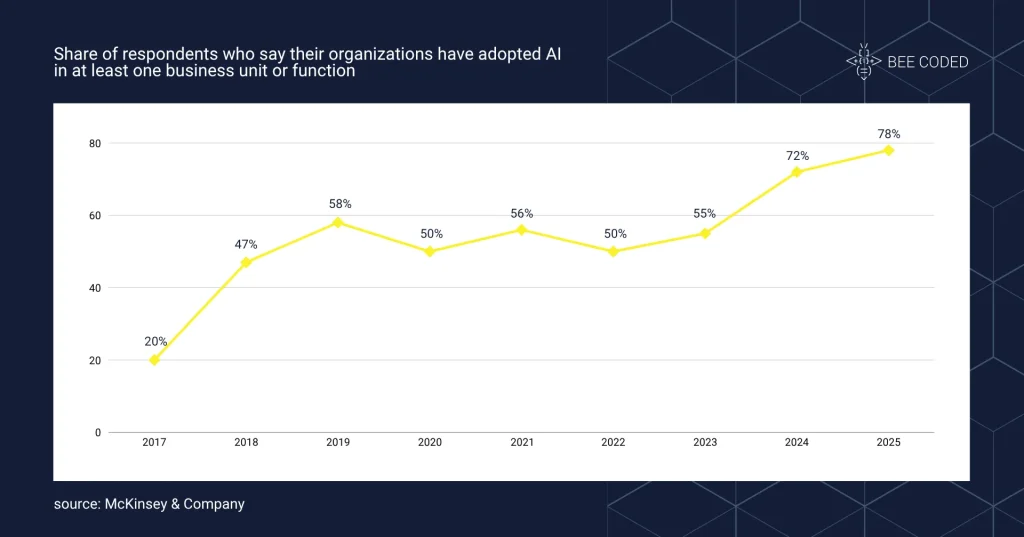
According to a series of studies by McKinsey, general AI adoption has grown from:
- 20% in 2017,
- to 50% in 2022,
- and up to 78% in 2025.
This means that most companies are already using AI in one form or another, in at least one area of their business. Plus, over 90% of companies plan to increase their AI investments in the next 3 years.
The most important promise of AI is that it frees us from manual, repetitive tasks that consume time and energy. Yet, there are still businesses that rely on manual data entry, meaning their internal processes depend largely on manually inputting data and inefficient workflows.
What really makes us raise an eyebrow is that these manual processes cost companies $2.9 trillion annually in productivity losses (source: www.kheyamind.ai). That’s huge.
However, integrating AI is not just about automating repetitive tasks. In fact, the future is about decision automation. So, we’re talking about intelligent automation capable of understanding and making decisions in real time.
Integrating AI into internal processes thus becomes a natural choice. It saves time, money, and energy, improves processes, and allows teams to focus on their creative, purely human, and highly valuable input.
Read on to discover everything you need to know about AI automation in 2025 and the impact it can have on your organization.
What Is AI Automation (and Why It Matters in 2025)
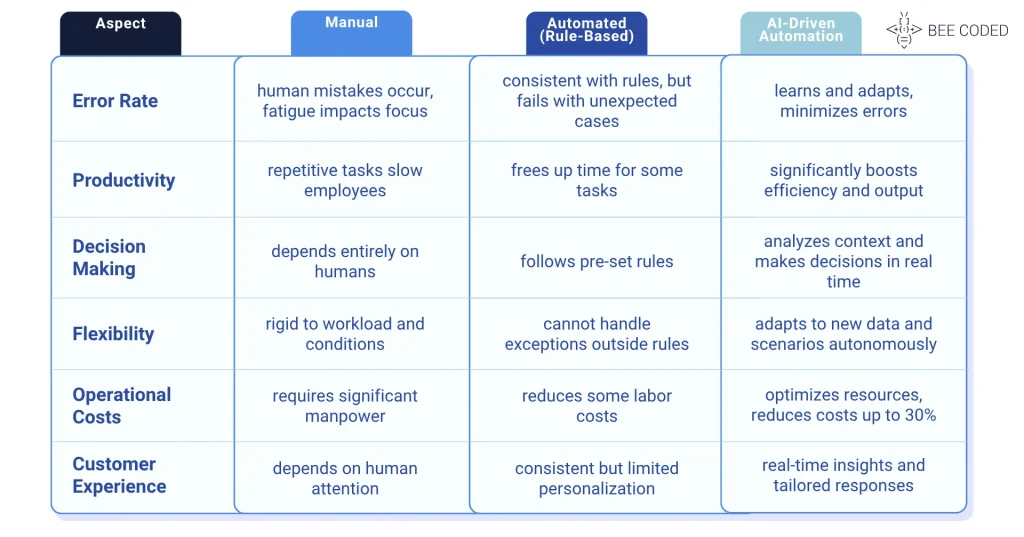
AI automation is the combination of automation and artificial intelligence, designed to automate both actions and decisions. Unlike traditional automation, which works based on fixed rules, AI adds a layer of understanding.
Classical (rule-based) automation is great for repetitive tasks. For example, imagine a system that automatically moves invoices from one folder to another. But if an invoice with an unexpected format appears, the system won’t know what to do.
In contrast, an AI-driven automation system can identify the type of document, extract relevant data regardless of format, and decide the next steps without relying on manually programmed rules.
RPA vs AI-driven automation
RPA (Robotic Process Automation)
As we’ve seen before, RPA means automating based on predefined rules. These systems basically mimic user actions. They are effective for simple and repetitive tasks that can be tedious for humans when performed at scale.
AI-driven Automation
This uses AI to analyze data, understand context, and most importantly, make decisions. You no longer need to tell it step by step what to do, because the system learns from the data you provide and can adapt.
Intelligent Process Automation (IPA)
IPA combines RPA with AI to automate complex processes. For example, in a legal department, IPA can analyze legal documents, identify relevant clauses, and automatically fill in certain sections of contracts. Unlike RPA, IPA understands both content and context.
Adaptive Decision-Making
Here comes a truly fascinating part: the system analyzes data in real time and makes decisions based on context. For example, in e-commerce, AI can decide the fastest and cheapest delivery route for each order, adapting to logistics conditions and stock availability.
Hyperautomation
Hyperautomation means integrating multiple technologies (RPA, AI, machine learning, analytics) into a fully orchestrated ecosystem. It’s a fascinating concept in automation trends 2025, because processes are no longer just automated; they are intelligently orchestrated from start to finish.
IPA, adaptive decision-making and hyperautomation are all forms of AI-driven automation and define the direction modern companies are heading.
The Key Benefits of AI Automation for Businesses
Reduce human error
Yes, humans make mistakes. Especially when repeating the same actions for hours, fatigue sets in, leading to reduced attention. AI takes the burden of manual and routine tasks off our shoulders, letting us focus on those that truly add creative human value.
Improves productivity
Employees using AI are 90% more likely to report higher productivity levels than those who don’t (Slack State of Work Report, 2023). Moreover, according to McKinsey, over 70% of employees believe that generative AI will change at least 30% of their work within the next two years.
If you’re a manager worried about how your team will react to AI adoption, it’s worth knowing that people are often more prepared for change than leaders expect. In many organizations, AI is seen as a real help, not a threat.
Improve speed and accuracy
AI-based automation saves an average of 3.6 hours per week per employee, roughly one month of work per year (Slack State of Work Report, 2023). AI doesn’t need sleep, breaks or holidays. It works nonstop with consistent accuracy.
Lower operational costs
AI systems can reduce operational costs by up to 30%. McKinsey highlights impressive results in distribution operations:
- 20–30% reduction in inventory
- 5–20% decrease in logistics costs
- 5–15% savings in procurement (source: flowforma.com)
Take a big name as an example: Netflix’s recommendation engine saves nearly $1 billion annually by predicting user priorities (source: ravenlabs.com).
Enhance customer experience
In SaaS products, AI can personalize user onboarding, provide real-time support through intelligent chatbots, and analyze customer feedback to further improve the experience. A client who receives fast, personalized responses feels like the product was made specifically for them. Ultimately, this will drive loyalty and retention.
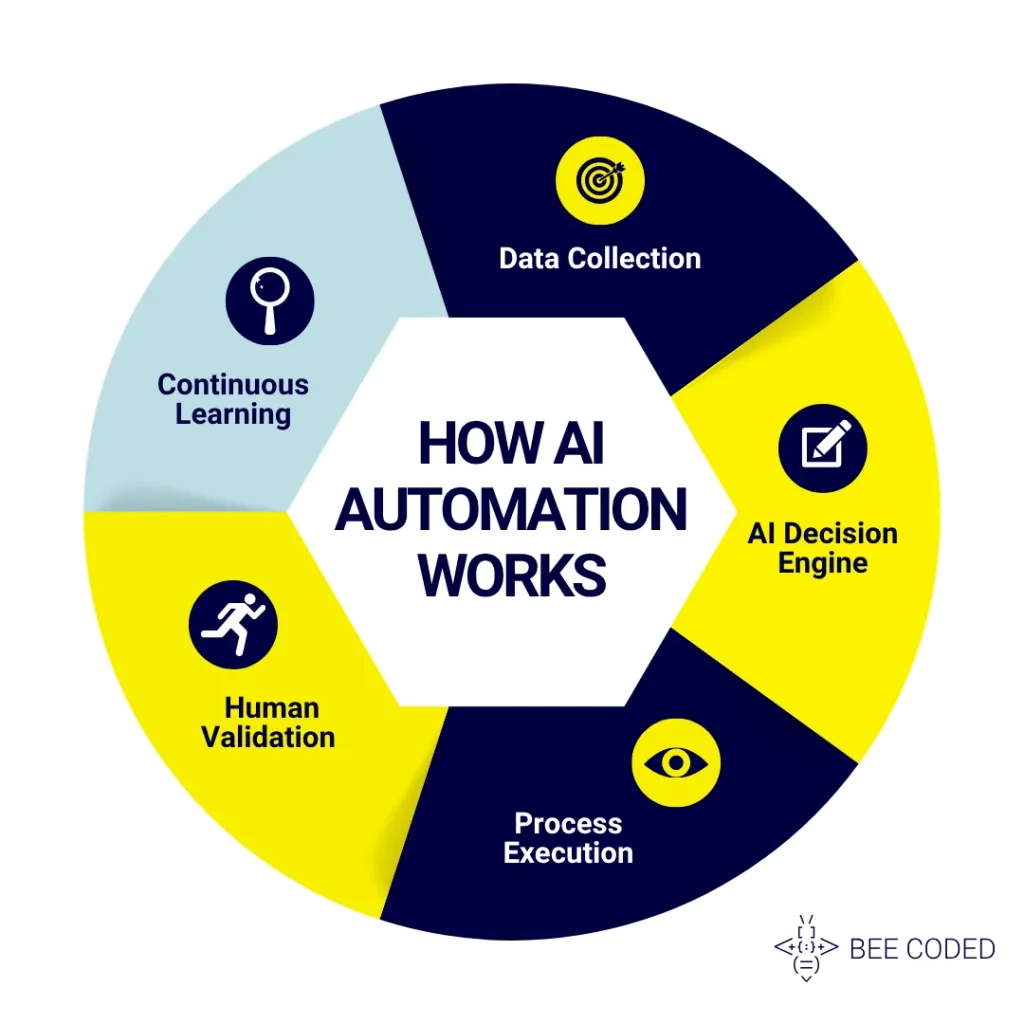
How AI Automation Works (Simplified Workflow)
1. Data Collection
The process starts with collecting data from various sources: databases, emails, online forms, scanned documents, etc. For example, in a financial system, AI can automatically extract relevant data from PDF invoices.
2. AI Decision Engine
The system analyzes the collected data, understands it, and decides on the next steps. For instance, it can determine if an invoice should be automatically approved or sent to a manager.
3. Process Execution
Decisions are then automatically executed. For example, approving the invoice from the previous step discussed.
4. Human Validation (optional)
For sensitive processes, humans can validate AI decisions before execution. For example, in recruitment, AI may suggest suitable candidates, but the final decision remains with HR.
5. Continuous Learning
What’s fascinating and extremely useful is that AI systems continuously learn from feedback and new data. This way, it becomes more precise and efficient over time.
Examples of AI Automation in Action
Enterprise
- invoice processing: AI can process invoices fully automatically, a concept often called “touchless accounts payable”. Instead of staff manually entering invoice data, AI can extract relevant details (like invoice number, amount, due date, and supplier) from PDF or scanned documents, match them against purchase orders, and approve payments according to pre-defined rules or learned patterns. Learn more in the article: The Future of Finance – Touchless AP Automation with Bee Coded
- HR approvals: AI can streamline HR workflows, such as approving leave requests or managing recruitment processes. For instance, by analyzing historical data, AI can suggest which leave requests can be automatically approved without conflicting with team schedules. Discover more here: HR Workflow Automation.
- analytics: AI analyzes large datasets, identifies patterns, and generates reports without manual intervention.
Saas
- user onboarding: AI personalizes onboarding steps based on user behaviour and engagement patterns. Instead of a generic tutorial, AI identifies which features a new user might need most and guides them accordingly.
- data syncing: AI ensures data between applications stays automatically updated and consistent in real time, avoiding duplicate entries or errors.
- client notifications: AI can send intelligent notifications or reminders to users based on their actions or inactivity, thus increasing engagement and retention.
E-commerce
- predictive restocking: AI predicts when products will run out based on historical sales data or seasonal trends. After that, orders are then automatically placed with suppliers before stock runs low.
- AI order routing: AI determines the most efficient way to fulfil orders by routing them to the optimal warehouse or courier. It considers location, stock levels, delivery costs, and shipping speed.
AI Workflow Automation Tools and Platforms
Low-code/no-code integration tools
Tools like Zapier, Make, or n8n.io are excellent for teams looking to quickly automate simple workflows. These iPaaS platforms work in the cloud, connecting applications via their internal APIs. A SaaS product manager can use them to sync data between CRM, marketing tools and internal apps without writing code.
RPA
UiPath automates simple tasks by mimicking user actions. It’s ideal for repetitive processes in applications without APIs, e.g., daily data extraction from a desktop program.
AI Agent
An AI agent is an application capable of performing complex tasks and interacting naturally with users. Microsoft Copilot is a great example, integrating AI directly into Office suites to assist with document drafting, data analysis, or presentation creation.
When to Use Existing Tools vs. Custom AI Automation (BEE CODED Approach)
Standard tools are great for tactical automation (relatively simple rule-based tasks), but for complex needs, you need custom AI software agents, which is exactly what we do at BEE CODED.
Our team builds strategic solutions, meaning software capable of making contextual decisions, handling exceptions, and partially replacing analytical roles.
Learn more about Bee Coded’s Automation Platform: On-Premise AI Agents That Work From Your Office.
The Future of Automation – From Manual to Autonomous
The transition from manual to autonomous is in full swing. Previously, the focus was on automating repetitive tasks. The future is about decision automation and AI orchestration (intelligently coordinating multiple systems to manage complex processes end-to-end).
For example, in a logistics company, AI orchestration can coordinate all inventory, routing, and delivery systems to optimize daily flows without human intervention.
Our role at BEE CODED
Want to develop a custom AI architecture? We can help!
- Deep integration with legacy systems without standard APIs
- On-premise security and strict GDPR compliance
- Decision logic capable of handling exceptions and partially replacing analytical roles
How BEE CODED Builds Intelligent Automation Systems
One of the first questions when choosing a partner is: “How will we work with them?”
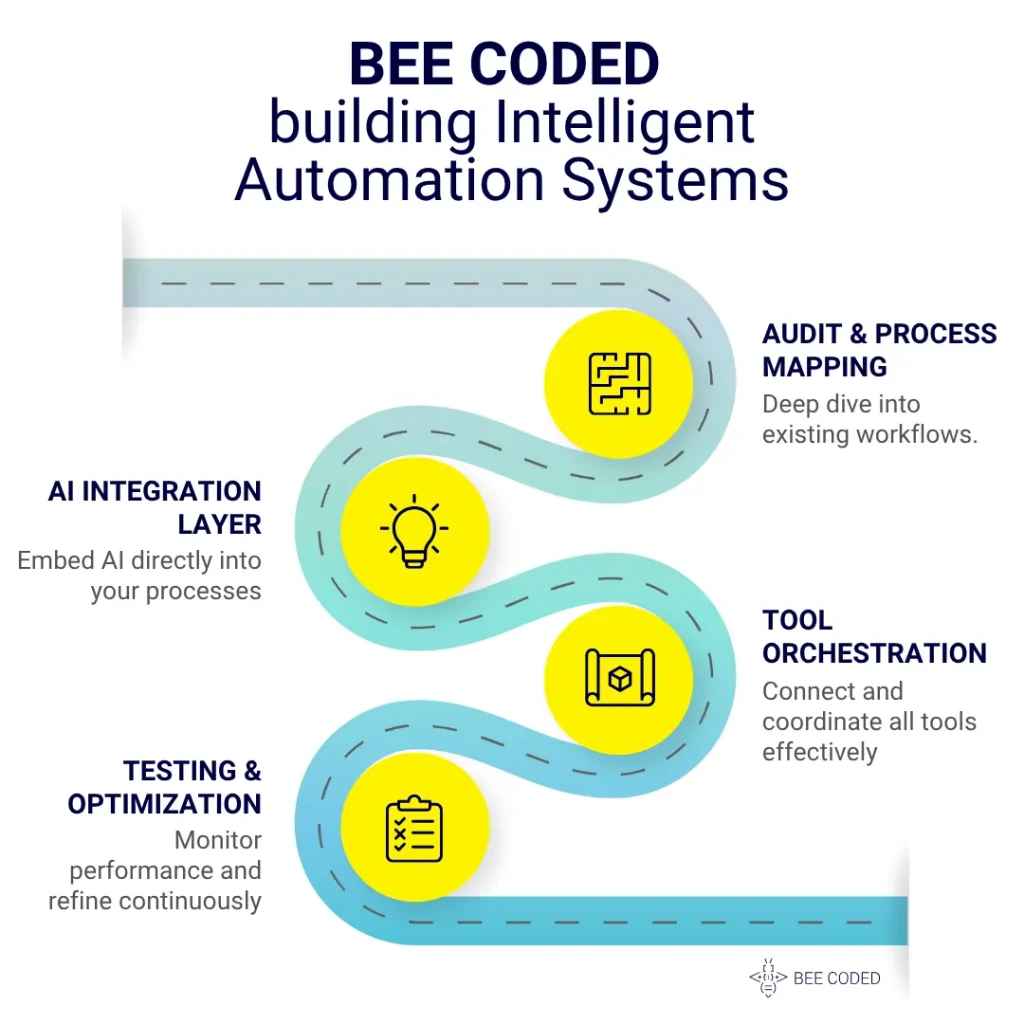
So here’s our framework:
- Audit & process mapping – We start by taking a deep dive into your existing workflows and operations. This means observing how your team currently works, identifying bottlenecks, repetitive tasks, and areas prone to human error.
- AI integration layer – Once we understand your processes, we integrate AI directly into your workflows. This involves designing AI models or agents that can analyse data and make decisions.
- Tool orchestration – We orchestrate all the tools so they communicate effectively and work together as a cohesive ecosystem.
- Testing & optimization – After deployment, we continuously monitor performance and refine the algorithms. This approach ensures that your automation solutions remain efficient and adaptable to changing business needs.
AI AUTOMATION WITH BEE CODED: STEP-BY-STEP PROCESS
Step 1 – We understand you
We will have a quick discovery session where you tell us about your workflow problems. Then we can shape the perfect solution for you.
Step 2 – We configure it fast
We implement the automated workflow and fully integrate it into your systems.
Step 3 – We stay by your side
We offer dedicated support from start to finish and constantly adjust the system based on your needs.
What you’ll gain with our personalized AI-based solution:
- 60–80% reduction in time spent on repetitive tasks
- Full integration with your business tools
- Clear insights automatically extracted from your data
- Up to 50% reduction in operational costs
See our automation services.
Summary: AI automation in 2025
AI automation in 2025 is shaping both the present and the future. Companies that quickly adopt AI workflow automation, intelligent automation and business process automation are the ones that will dominate the market in the coming years.
Stay one step ahead. Take advantage of automation trends 2025, transform your internal processes, and give your team the tools they need to excel.
Contact our BEE CODED TEAM to implement AI automation tailored to your workflows.