- Industry insights
- People in tech
- Product development
- Tech trends at BEECODED
- 3 Dec 2025
AI Automation for SaaS Marketing: Understanding User Behavior and Driving Engagement
Learn how we can boost SaaS client engagement with AI.
Table of contents
- Why AI Matters in SaaS Marketing
- Understanding User Behavior Through AI Analytics
- Automating SaaS Marketing Workflows with AI
- Predictive Engagement and Retention Automation
- Personalization at Scale – The Future of SaaS Growth
- BEE CODED’s Approach to AI Marketing Automation
- The Future of AI-Powered Engagement (2025–2030)
- Conclusion
- FAQ: AI Automation for SaaS Marketing
Contributors


AI automation is gaining more and more traction across SaaS (from HR to customer service and beyond). But how do we implement AI automation in a creative field where the human touch is deeply valuable, such as marketing?
Well, AI marketing automation tools aren’t built to replace creativity. Their role is to optimize, process, and interpret large volumes of behavioral data, user preferences, and interaction history. It can even predict future behavior, helping us improve the customer experience for SaaS products in ways that were previously impossible. Thus, we get a better picture of what users want today and what they’ll likely want tomorrow.
According to Salesforce, 68% of service professionals already use or plan to use AI to improve customer experiences. Therefore, to keep pace with technological advancements, it’s important to explore how we can effectively utilize AI in every area of the business to bring added value to the product we offer. Read on to discover more about AI automation for SaaS marketing and how we can boost SaaS client engagement with AI.
Why AI Matters in SaaS Marketing
1. Scalability
AI automation eliminates repetitive and time-consuming tasks, reducing the burden of high-volume customer inquiries on human agents. For example, imagine receiving hundreds of support requests weekly (most with the same three questions). Instead of spending hours responding manually, AI can categorize, solve, and automate replies instantly, while the human team focuses on strategic tasks.
2. Engagement
When users feel understood, they stay. Through hyper-personalization, users receive relevant content, recommendations, and messaging tailored to their needs. Thus, users get exactly what they need without searching for it. They feel understood (like the product was built for them personally) and engagement increases naturally. You build deeper customer relationships and stronger product adoption.
3. Prediction
This is an extremely important value of AI: the fact that we not only manage to make them more engaged now, but we also succeed in figuring out what will keep them engaged in the future. This means lower churn, better upsell timing, smarter onboarding, and overall longer product lifespan.
Understanding User Behavior Through AI Analytics
Every SaaS platform wants the same two things:
- high loyalty
- low churn
These two work hand in hand because improving loyalty reduces the likelihood of users abandoning the product. But what exactly is user behavior analytics?
What is User Behavior Analytics?
Also known as entity behavior analytics, it’s the process of collecting and analyzing data related to how users interact with a SaaS product.
It helps us understand:
- how users navigate the product
- what they find valuable
- what they dislike or avoid
- how the experience can be improved.
With these insights, product teams can optimize functionality and marketing flow to better support user needs.
The Four Core Types of User Behavior Data
According to Userpilot, user behavior falls into four main categories:
- Engagement Data: micro-interactions like clicks, scroll depth, button taps. These show how the user interacts with the product on a micro-level.
- Usage Data: this one answers the question: how much do users use the product and which features do they like the most? This reveals feature adoption.
- User Journey Data: this one tracks each step inside the product, helping you identify drop-off zones and friction points. It answers the question: how do users navigate the product from A to Z?
- Feedback Data: ratings, surveys, feature requests. This is the voice of the user.
How AI Collects and Analyzes User Behavior Data
AI listens to user behavior the same way an experienced marketer does, only at scale.
- Clickstream tracking: monitors sequences of clicks and navigation paths to map decision flow.
- In-app event tracking: records feature usage, onboarding steps, video completions, billing actions.
- Heatmaps: visual highlights showing where users hover, scroll, or ignore.
Automating SaaS Marketing Workflows with AI
AI can automate workflows across the whole marketing ecosystem. Here are the most impactful areas:
Email & Campaign Automation
Platforms like HubSpot, Customer.io, and ActiveCampaign integrate AI to analyze user segments automatically and send personalized emails based on behavior. For example, if the user tries a feature 3 times in a row, AI sends a how-to guide or a video demo.
AI-Powered A/B Testing & Dynamic Content
Instead of testing manually, AI runs multiple variations and selects the highest-performing one. Plus, content blocks change dynamically based on user preferences, session history, and predicted intent.
Integrations with Make, Zapier, Notion AI
Automation gets even stronger when tools talk to each other. Data flows seamlessly across platforms, you centralize behavior signals, automate triggers, generate messaging, and sync CRM activity instantly.
Predictive Engagement and Retention Automation
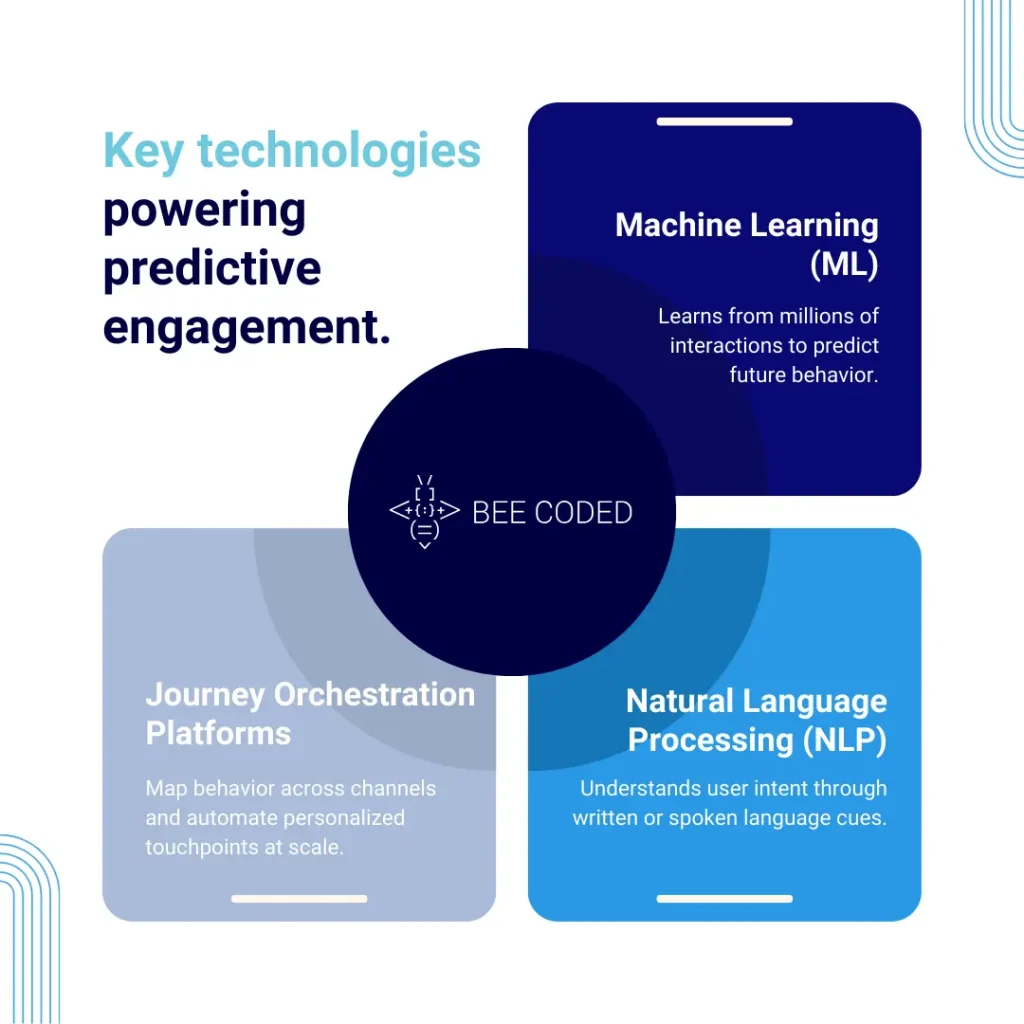
The best kind of support is the one a user never has to ask for (because the system knows it already). Imagine a user stuck at checkout on an e-commerce platform, where the cursor moves toward the exit tab. The system predicts abandonment risk and triggers a help chat automatically (or offers a discount, support hint, or product recommendation to save the conversion).
Let’s see the technologies powering this response.
Personalization at Scale – The Future of SaaS Growth
A recent McKinsey report describes the concept of next best experience, the core of hyper-personalization. This approach refers to the ability to deliver the right message, to the right person, at the right time. AI-powered personalization uses real-time analytics, ML models, and user behavior history to craft tailored experiences for every customer.
The guiding question here is: What does this user need most at this very moment?
How AI Personalizes in Real Time
1. Data Stream: observing behavior
AI collects millions of micro-signals in seconds (pages viewed, time spent, search intent, clicks). Each action becomes a data point.
2. Algorithm Modeling: predicting needs
ML models compare current behavior with historical patterns to calculate the most likely next action.
3. Dynamic Action Delivery
The interface adapts while the user is still browsing (new recommendations, new flow etc).
Case Study: Personalization with AI
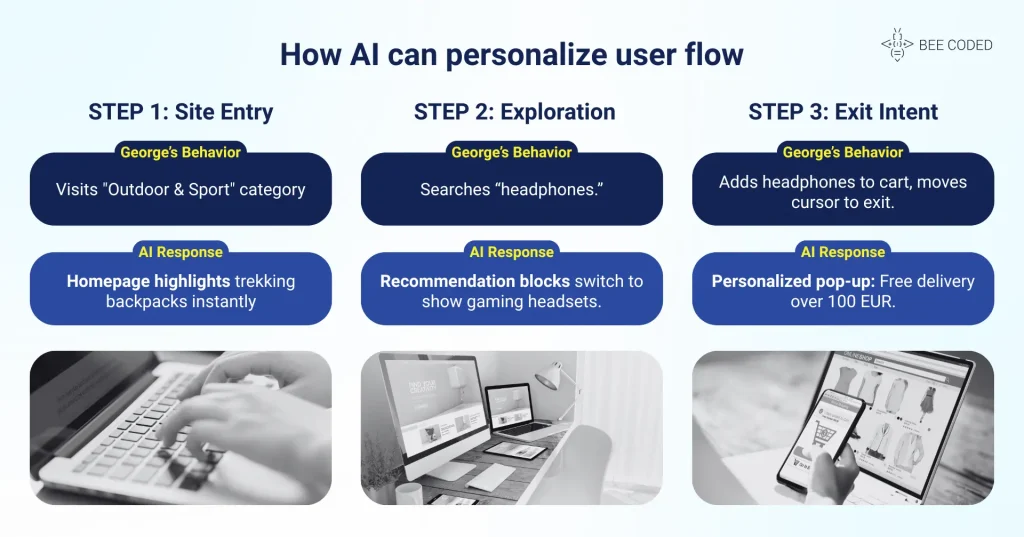
Let’s imagine George, who accessed an e-commerce platform and recently purchased hiking gear (tent, boots). He has also searched for gaming items in the last two sessions but has not purchased anything from that category yet. See below how the personalization flow might look:
BEE CODED’s Approach to AI Marketing Automation
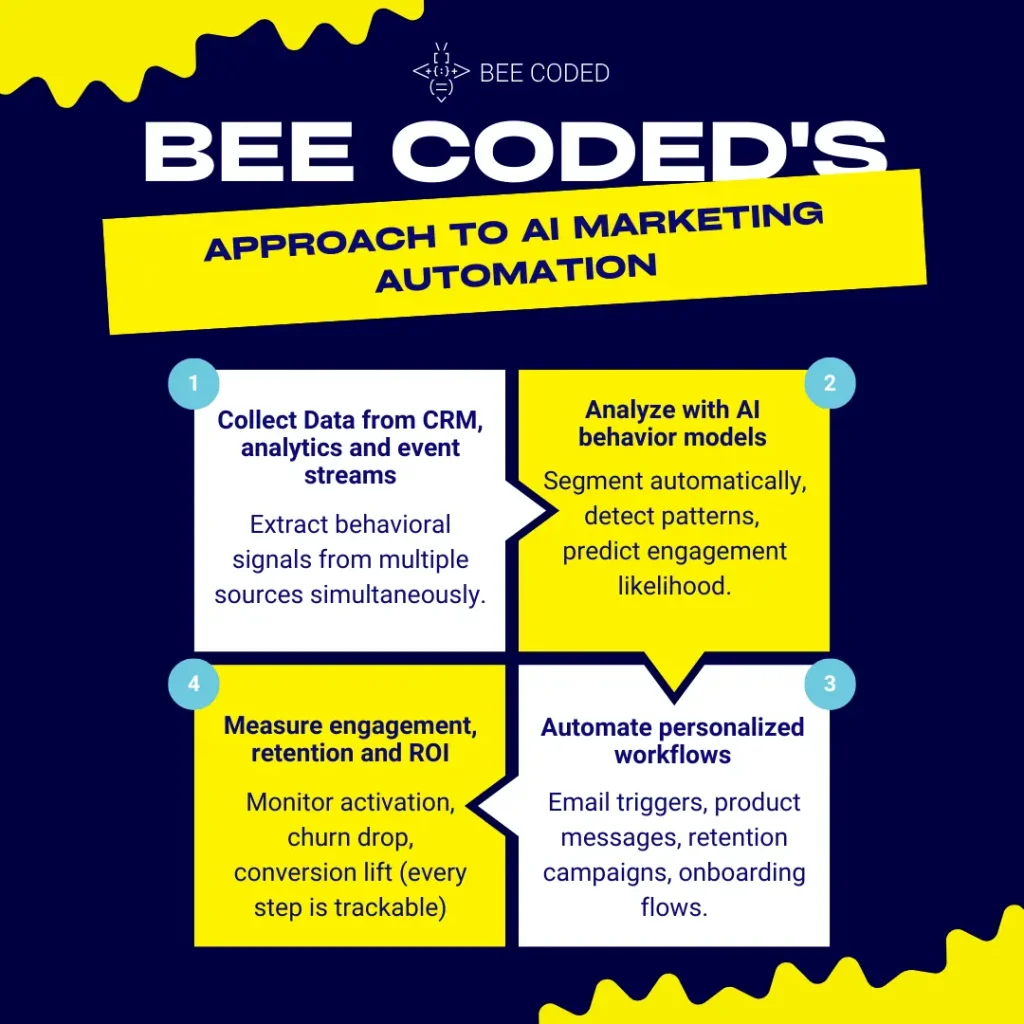
Here’s how our workflow looks internally when building AI-driven engagement strategies:
1. Multisource Data Collection
We start by pulling information from every available channel to get a complete image of the user:
- CRM databases where user identities, preferences and subscription details live
- product analytics dashboards that track clicks, heatmaps, and feature usage
- in-app event logs that show frustrations, drop-off points and high-value behaviors
- user journey maps that reveal progression, friction and the emotional flow behind decisions.
That means AI sees all the behavior in context. It knows who the user is, how they navigate, why they convert or churn, and what experience would keep them engaged longer.
2. AI Behavior Modelling
Once the data is collected, machine learning starts working, scanning millions of interactions and identifying:
- friction points where users hesitate, slow down, or abandon
- churn risk predictions based on early warning behaviors
- purchase probability, interest spikes and emotional buying signals.
3. Automated Workflows
At this point, AI automatically triggers the right response at the perfect time. For example:
- onboarding guidance when users slow down on setup screens
- upsell nudges when usage spikes on premium features
- retention emails when churn likelihood increases
- win-back flows when a user becomes inactive
- contextual campaigns based on real-time in-app signals.
And the beauty of it is that the more the system learns, the more natural each interaction feels.
4. Measurable Outcomes
We measure success through:
- retention curves (how many users stay active over time)
- activation rates (how fast new users reach “aha” moments)
- churn metrics (whether we reduce abandonment through predictive actions)
- engagement depth (how often users return, explore, and convert).
And because the automation learns continuously, every month is smarter than the last one.
The Future of AI-Powered Engagement (2025–2030)
AI is becoming a decision-making partner. In the next few years, SaaS companies will integrate AI at the core of every growth initiative. Here’s what we can expect:
AI Co-Pilots for Growth Teams
Imagine a system that sits beside marketers like a data-trained teammate that could:
- generate content variations predicted to convert best
- recommend pricing or positioning adjustments per audience
- simulate outcomes before campaigns are launched.
Teams will move faster and scale quicker.
NLP Conversational Experiences
Support won’t feel rigid anymore. It will feel like a conversation with someone who knows what the user wants. These AI assistants won’t sound stiff or templated. They’ll learn brand tone, respond emotionally, adapt vocabulary to each user profile.
Predictive Content Optimization
It looks like the future is about prediction and adaptation. Thus, AI will be able to help marketers with actions like:
- rewriting headlines to match behavior patterns
- personalizing offers depending on purchase likelihood
- swapping visuals based on scroll attention, etc.
See top AI trends shaping the future of SaaS.
Conclusion
AI automation for SaaS marketing means: smarter workflows, deeper user understanding
and higher engagement and retention.
If you’re ready to automate intelligently and grow with purpose, let our BEE CODED team help you build AI workflows that drive engagement and scale your SaaS.
Discover our SaaS Consulting & Development Services as well as our Business Process Automation Services.
Still got questions? Reach out to us.
FAQ: AI Automation for SaaS Marketing
How does AI improve SaaS marketing?
It analyzes user data, predicts needs, personalizes communication, and automates repetitive tasks. This leads to better targeting, higher conversions, and more efficient campaigns.
What is AI user behavior analytics?
It’s the process of collecting and interpreting user actions inside a product to understand patterns, preferences, and intent. These insights help optimize onboarding, UX, and messaging.
How can AI automation increase engagement in SaaS?
By delivering timely messages, personalized content, product recommendations, and automated triggers based on user behavior. This keeps users active and reduces churn.
How does BEE CODED help SaaS companies drive user engagement?
By tracking user activity, identifying drop-off points, and triggering automated responses tailored to each user’s actions. This improves onboarding, retention, and lifetime value.