- Industry insights
- People in tech
- Product development
- Tech trends at BEECODED
- 20 Oct 2025
AI Workflow Automation in 2025: From Process Efficiency to Intelligent Systems
Read on and find out what AI workflow automation is, what benefits it brings, how it works.
Table of contents
- What Is AI Workflow Automation (and Why It Matters in 2025)
- Key Benefits of AI Workflow Automation
- How AI Workflow Automation Works (Step by Step)
- Examples of AI Workflow Automation in Action
- Tools and Platforms Driving Workflow Automation in 2025
- The Future – From Automated to Intelligent Workflows
- How BEE CODED Designs AI Workflow Automation
- Conclusion
Contributors


Do you have time-consuming repetitive processes? Automate them!
That’s what we hear most often when the conversation turns to streamlining workflows. However, nowadays, automation is no longer limited to simple tasks but extends to situations that require real decision-making capacity. And this huge leap has been made possible thanks to artificial intelligence.
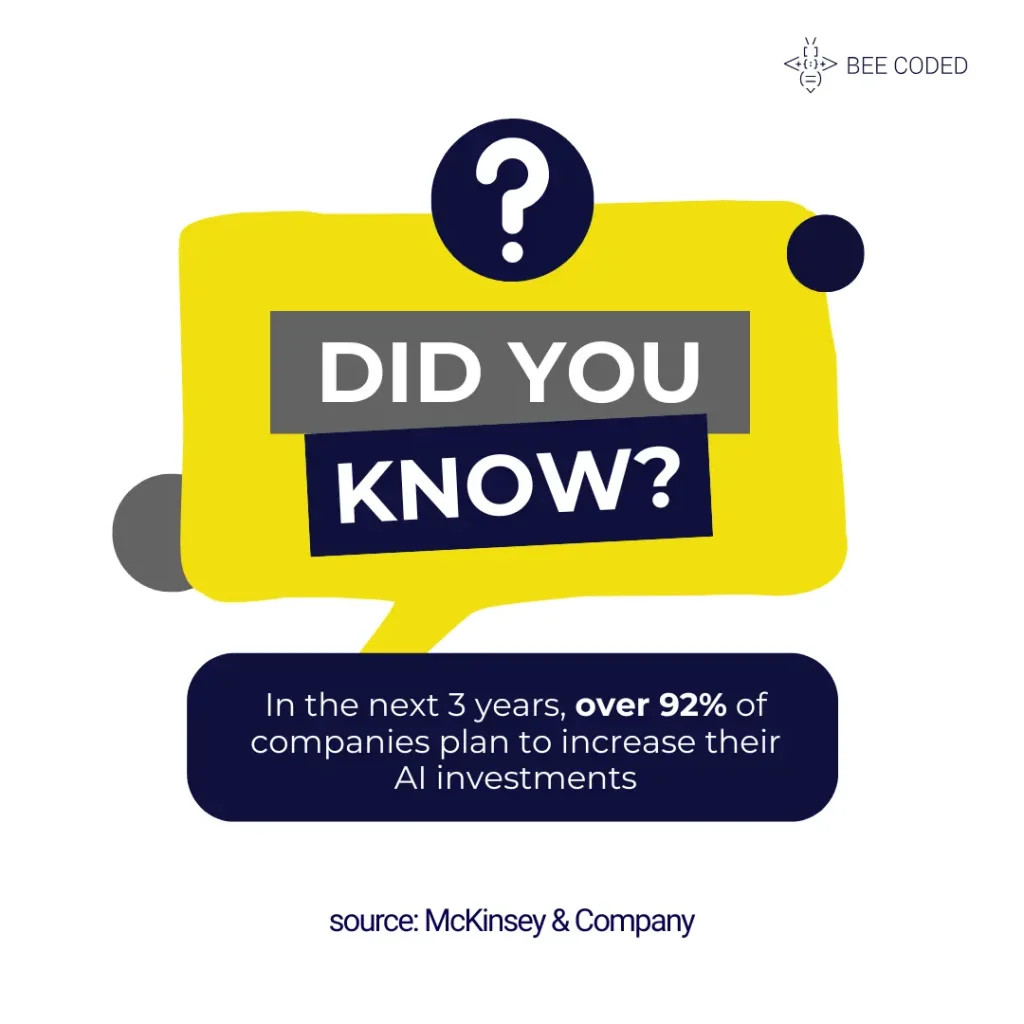
In the next three years, over 92% of companies plan to increase their AI investments (according to McKinsey & Company). And one of the most important niches within this trend is AI Workflow Automation.
Read on and find out what AI workflow automation is, what benefits it brings, how it works, and concrete examples of how you can implement it in your own company. Make sure you’re among those who ride the wave of evolution and stay informed. Let’s get started!
What Is AI Workflow Automation (and Why It Matters in 2025)
AI Workflow Automation is a method that combines two major components:
- Rule-based automation – the “traditional” side, which quickly executes simple, repetitive tasks.
- AI decision-making capabilities – the one that intervenes when data is complex, analyzing, learning from experience, and making decisions based on context.
In other words, two powerful elements come together to deliver extraordinary results.
Let’s take an example. Imagine we automate customer support email management. Rule-based automation takes over the task of automatically creating a new ticket every time an email arrives (a clear and repetitive action). Then, the AI decision-making capability intervenes to read the email content, assess the emotional tone of the customer (for example, if he is angry or calm), and automatically decide the real level of urgency. Based on this analysis, the system once again uses a rule to send the ticket either to a normal queue or to an urgent one, depending on the emotional tone detected.
Pretty exciting, right?
You may also come across the term AI-powered Automation. In practice, when talking about the automation of large processes, the terms AI-powered automation and AI workflow automation can be used to describe the same thing, but there is a subtle difference between them.
- AI-powered Automation – a broader term referring to any use of AI to automate a task, whether it’s simple (like a chatbot answering a question) or complex.
- AI Workflow Automation – a specific application focused on the entire business process (the workflow), from start to finish, ensuring that all interconnected steps flow smoothly.
Key Benefits of AI Workflow Automation
Even from afar, the advantages are obvious, but let’s zoom in on the concrete benefits:
Reducing Errors
Human errors occur especially in the context of repetitive tasks, which increase fatigue and decrease resistance to frustration. Therefore, Here, the benefit is twofold:
- Once AI takes over the task, errors decrease.
- Fatigue and frustration drop as employees can focus on more complex, higher-value, and more rewarding tasks.
Boosting Productivity
As we’ve already seen, when employers assign key responsibilities to employees instead of meaningless repetitive chores, motivation (and consequently engagement) increases.
People feel that their work has greater purpose, beyond carrying out banal and routine tasks. Moreover, employees using AI are 90% more likely to report higher productivity levels than those who don’t (Slack State of Work Report, 2023).
Saving Time and Money
As the saying goes, time is money. By reducing the time spent on tasks, AI systems can lower operational costs by up to 30%.
Scalability Without Increasing Headcount
AI is like your digital employee. It doesn’t need breaks. It processes tasks instantly, no matter how much volume increases. This way, you avoid burning out your team while making sure you scale efficiently.
How AI Workflow Automation Works (Step by Step)
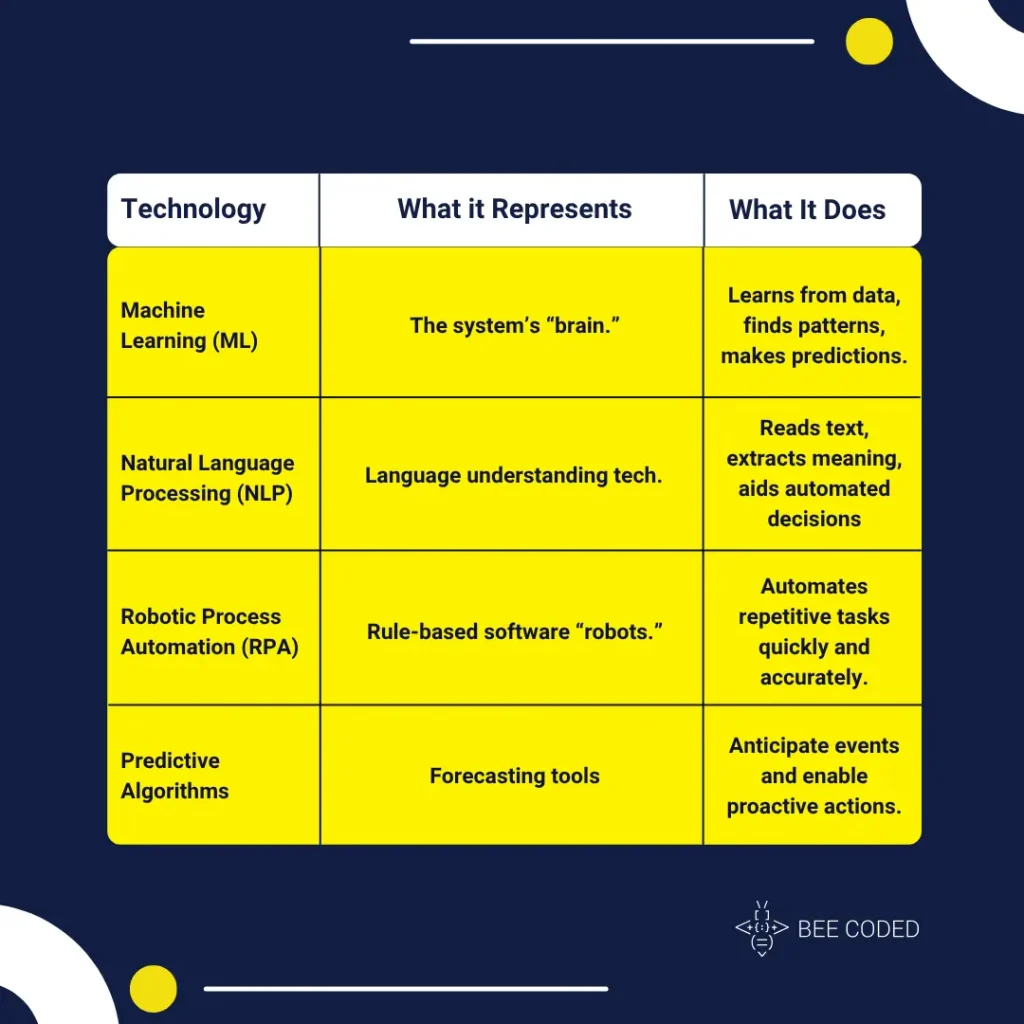
Behind any intelligent workflow automation system lies a combination of key technologies working together:
- Machine Learning (ML) – the “brain” that analyzes historical data, learns patterns, and makes predictions. For example, an ML model can learn which types of requests are urgent by analyzing thousands of past cases.
- Natural Language Processing (NLP) – enables systems to understand human language. NLP can read emails, documents, or messages, extract meaning and tone, and support contextual automated decisions.
- Robotic Process Automation (RPA) – executes repetitive tasks (moving data, sending notifications, etc.) like a “robot” that follows instructions extremely fast and accurately.
Predictive Algorithms – anticipate future events or needs so the system acts proactively rather than reactively (e.g., predicting a bottleneck in a process and rerouting the workflow before it happens).
The Stages of AI Workflow Automation
- Data collection – the first step involves gathering data from all relevant sources (CRM, emails, ERP, forms, etc.) to build a solid foundation.
- AI decision model – then, an AI model processes the collected data, analyzes it, classifies it, and decides the next steps.
- Trigger execution – the AI’s decision automatically triggers a predefined action (e.g., sending a document for validation).
- Human validation (optional) – in sensitive cases, a human can review and validate the AI’s decision.
- Continuous learning – the system constantly learns from outcomes, refining its models and becoming more accurate over time.
Read more about AI automation in 2025 here.
Examples of AI Workflow Automation in Action
SaaS Onboarding Automation
In SaaS companies, the onboarding process involves multiple steps (welcome email, account activation, initial setup). AI workflow automation allows each step to be triggered automatically depending on user actions, drastically reducing the time to full activation.
Finance Approval Processes
In finance, approvals can be slow and bureaucratic. AI automation can read and validate documents, analyze risks, and automatically approve simple transactions. With our AI-driven automation systems, financial teams saved up to $100,000 per year through smart automation. Learn more about this here.
HR Document Validation
Checking contracts, certificates, and other HR documents consume a lot of time. AI can automatically analyze documents, identify missing information, warn you before deadlines, and even trigger automatic renewals. Learn about contract renewal automation in our article here.
IT Ticket Triage with NLP
IT departments receive hundreds of tickets daily. NLP can read the problem description, automatically classify it (network, software, hardware, etc.), and instantly route it to the right team, thus reducing response times.
Tools and Platforms Driving Workflow Automation in 2025
Let’s look at a series of popular tools in 2025 when it comes to automation.
- Zapier – connects apps and creates no-code automated flows, ideal for simple tasks.
- Make (formerly Integromat) – allows building complex, visual scenarios for cross-department processes.
- UiPath – a leader in RPA, used for robust automation in large companies.
- n8n.io – an open-source, flexible alternative for companies that want full data control.
- Microsoft Power Automate – integrated into the Microsoft ecosystem, easy to use in corporate environments.
The Future – From Automated to Intelligent Workflows
With the help of AI, automation is reaching previously unimaginable levels. We’ve moved from simple triggers (the basis of traditional automation) to AI orchestration.
- Simple triggers: “If A happens, do B.” They wait for a specific event and then execute one predefined action.
- Limitations: They can’t make complex decisions, learn, or adapt to changing situations.
- Limitations: They can’t make complex decisions, learn, or adapt to changing situations.
- AI orchestration: a complex, intelligent system overseeing multiple interconnected steps. Unlike simple triggers, it can choose the best path, change the order of steps, and learn from previous results.
To make it easier to visualize, imagine a simple trigger as an elevator button. You press it and it knows what to do, but it doesn’t take into account if you’re in a hurry, if it’s overcrowded, etc. An AI orchestration is like a GPS – it analyzes traffic, learns from history, makes decisions to avoid a crowded area, changes the route when the situation requires it, etc.
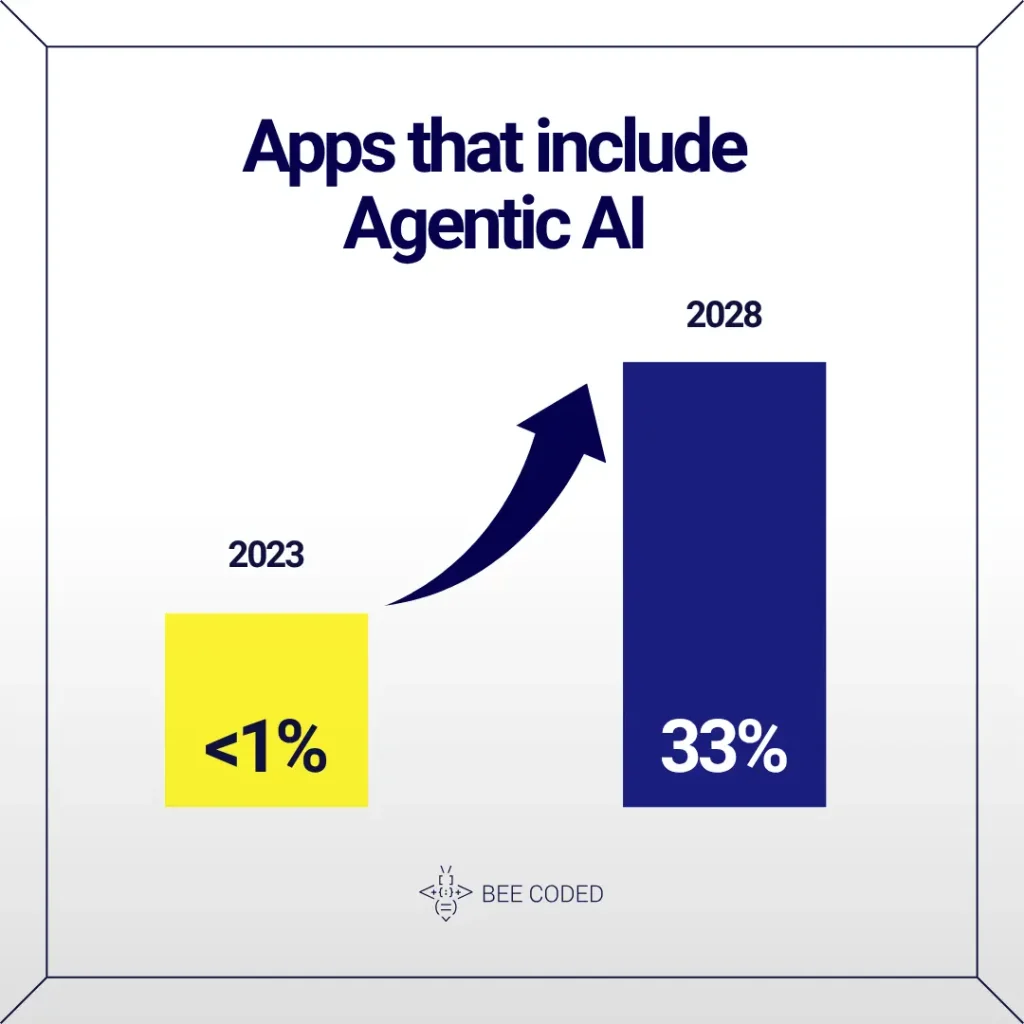
An important role in orchestrating workflows is also played by Agentic AI. Agentic AI acts as an autonomous decision and execution agent within an AI orchestration system.According to Gartner, by 2028, 33% of enterprise software applications will include agentic AI, up from less than 1% in 2024, enabling 15% of day-to-day work decisions to be made autonomously.
How BEE CODED Designs AI Workflow Automation
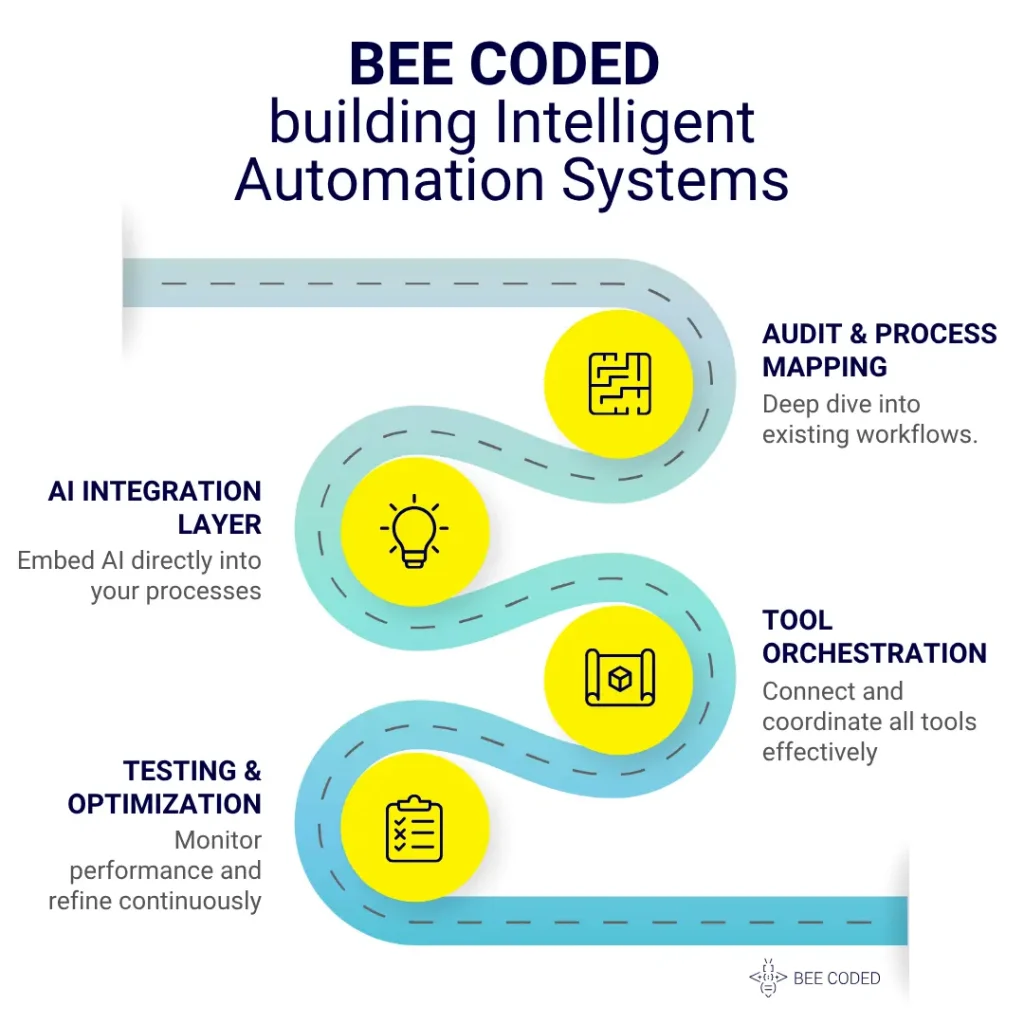
At BEE CODED, we use a clear framework to implement AI process automation:
- Workflow audit – We analyze your existing processes in detail: how your team works, which tasks are repetitive, where errors occur, and where improvements can be made. We answer questions like:
- Which tasks consume the most time?
- Which steps can we automate without compromising quality?
- AI integration – After the audit, we integrate AI into the identified workflows. We define models, choose the right algorithms, and set how AI will make decisions. We answer questions like:
- What type of data needs to be processed?
- Which decisions can be delegated to AI?
- What level of autonomy is appropriate?
- Tool orchestration – We orchestrate all the tools so they communicate effectively and work together as a cohesive ecosystem.
- Testing & optimization – Once implemented, we monitor performance and continuously optimize.
- Continuous learning loops – We create continuous learning loops so the system constantly improves. Essentially, the more you use it, the smarter it gets, adapting to your organization’s specific reality.
Conclusion
We can all agree that AI workflow automation is the next natural step in digital transformation. We are talking about reducing time, eliminating errors, increasing productivity, and transforming processes into an intelligent system. Companies that adopt these solutions early will have a clear competitive advantage in the coming years, in a landscape where business process automation AI is becoming the norm.
Discover how BEE CODED can automate your workflows and reduce manual effort through intelligent AI systems. See our automation services here and contact us now for your project!