- Industry insights
- People in tech
- Product development
- Tech trends at BEECODED
- 5 Sep 2025
Omnichannel Tier-1 Support: Automate & Scale Your Customer Service with BEE CODED
Customer support is one of the most important parts of your business because it’s the direct contact point with your customers.
Table of contents
Contributors


Imagine this: a customer sends a WhatsApp message asking about their order delivery. At the same time, that same customer also writes an email with the exact same issue. Who answers first? And what happens if the answers are different?
Well, without a centralized system, customer support can quickly turn into a small chaos. And that’s the last thing you want. Customer experience statistics show that 65% of customers stop buying from a brand after just one or two negative support experiences (according to zoom.com). That’s a huge percentage, and one that should make us pay attention to the consistency and quality of responses.
Customer support is one of the most important parts of your business because it’s the direct contact point with your customers. In today’s article, we’ll discuss how an omnichannel customer support system with BEE CODED works—and why it’s a safe, fast and scalable solution for your company.
What is omnichannel customer support?
Omnichannel support means providing your customers with a unified experience, no matter which communication channel they use to reach you. If we look at the root of the word: omni means all, and channel refers to a medium for interaction. So, we can remember it as: all communication channels gathered into one centralized system.
Imagine you have a single reception desk. A customer can walk in through the WhatsApp door, the email door, the chat door, or even via a phone call. But no matter which door they use, they always arrive at the same reception.
Benefits of omnichannel support
Such a system brings three major advantages:
1) Speed – customers receive instant answers to routine questions.
2) Consistency – everyone gets the same approved responses, regardless of channel.
3) Security (GDPR) – personal data is handled correctly, with no risk of being sent through unsafe channels.
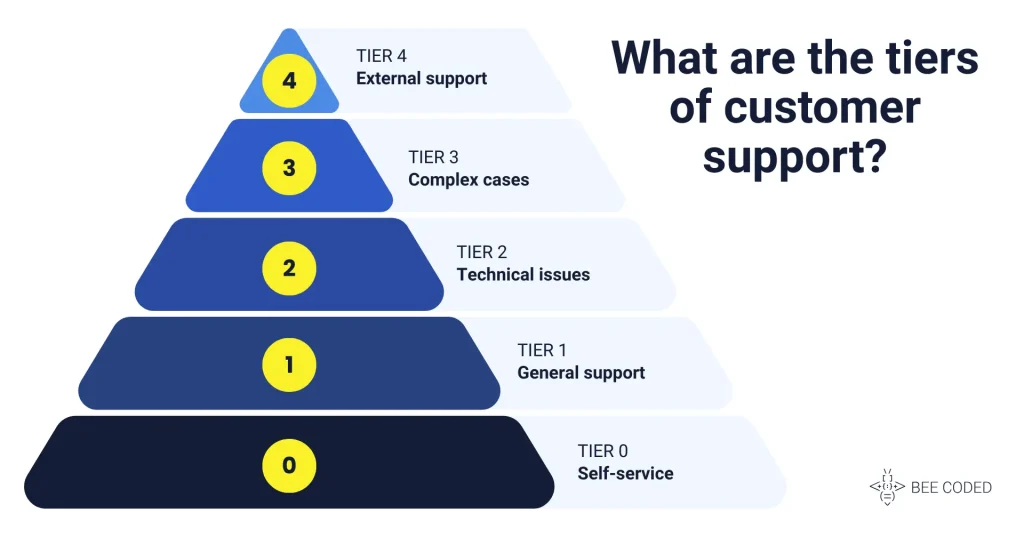
What are the tiers of customer support?
In general, customer support is divided into levels (called tiers), starting with the simplest questions and moving up to the most complex:
Tier 0 – Self-service
Here, the customers find the answer themselves. Examples: FAQ sections, video tutorials, blog articles etc.
Tier 1 – General support
The agents of tire 1 are the first line of contact, handling common customer requests (e.g., account setup, account-related questions etc).
Tier 2 – Technical issues
These are questions that require an experienced agent or access to internal systems. For example: “My payment wasn’t processed correctly” or “I’m getting an error in the app.” At this level, a standard answer isn’t enough, so you need an agent that analysis the situation.
Tier 3 – Complex cases
This category includes more complex situations, sometimes without a standard solution, requiring detailed investigation or managerial decisions. Example: “My order has missing products.”
Tier 4 – External support
The last level involves external partners or suppliers. For example, when the issue is related to a third-party service or a manufacturer’s warranty.
With Omnichannel Tier-1 Support by BEE CODED, the first level (general questions) is handled almost entirely automatically. This drastically reduces the workload for agents and allows them to focus on Tier 2 and Tier 3, where their expertise makes a real difference.
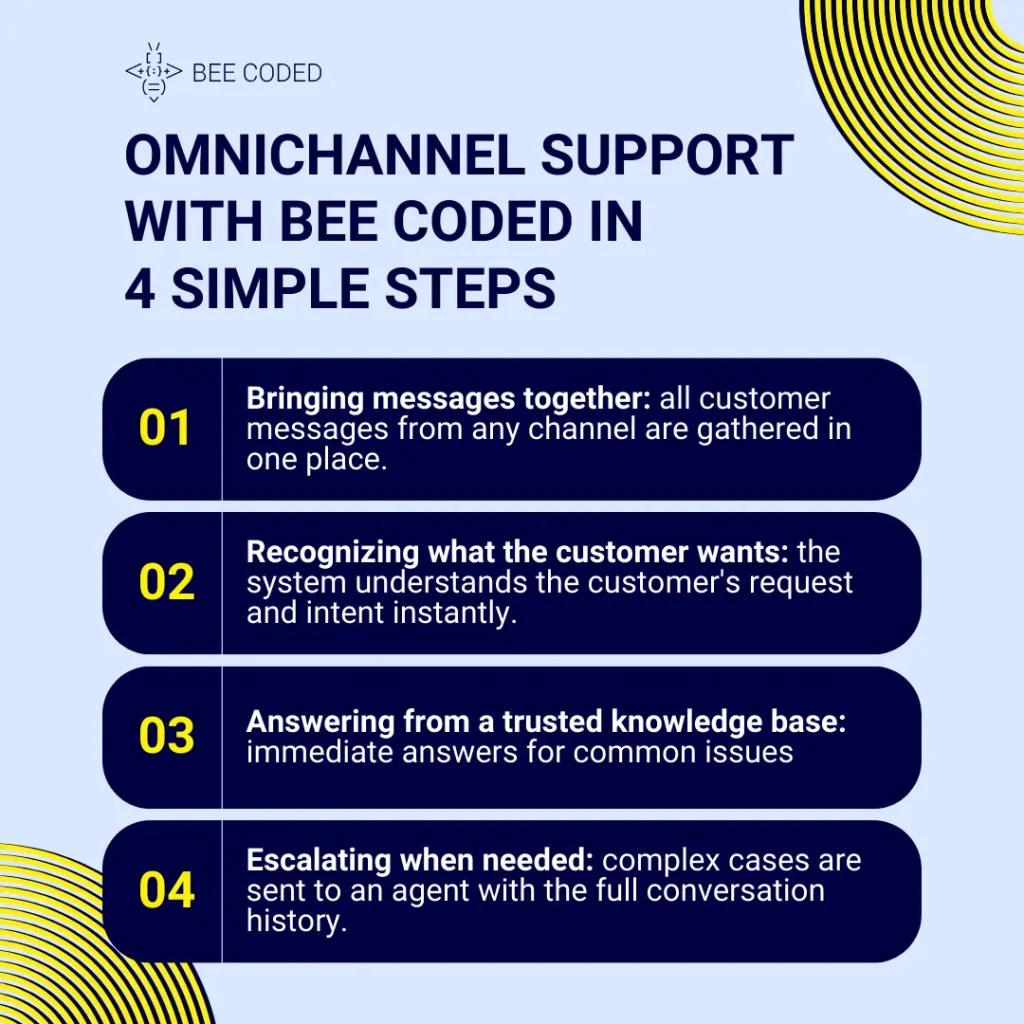
Omnichannel support with BEE CODED in 4 simple steps
Now let’s see how omnichannel support by BEE CODED helps your business:
Step 1: Bringing messages together
First, we gather all messages in one place, no matter which channel they came from. The system connects to WhatsApp Business and automatically retrieves conversations, monitors a shared email address and centralizes all received messages. It also turns website chat form submissions into text messages within the same interface, and even transcribes phone calls into text so they can be handled just like written messages.
Step 2: Recognizing what the customer wants
Through intent recognition (a program’s ability to understand what you want to do), the system identifies the customer’s request. Here are a few examples of questions and the recognized intent, transformed into clear response templates:
- “Where’s my order?” → order status
- “Send me the invoice” → invoice copy
- “I forgot my password” → password reset
The system works in both Romanian and English, maintaining a consistent and friendly tone.
Step 3: Answering from a trusted knowledge base
At this step, the customer receives an answer right away, without waiting or being redirected. The system pulls information from a centralized, verified database (single source of truth), guaranteeing that messages are correct and consistent.
Automated responses are short and to the point, but can also include extra links to useful resources such as a guide or a help page.
If a customer requests sensitive data (like personal information or order status), it is not displayed directly in chat. Instead, the system sends them a secure link to a form or portal where they can safely access their data.
Step 4: Escalating when needed
When complex cases arise, they’re sent to a human agent. The full conversation history is forwarded to the agent, saving time and avoiding customer frustration, since they don’t have to repeat their situation.
GDPR: A top priority for customer trust
Today, the word GDPR is everywhere, and customers are increasingly aware of their rights. They need to feel safe, knowing their personal data is handled responsibly. That’s why the BEE CODED system is built with strict compliance to these principles: only the data needed, safe storage, and quick deletion upon request.
What changes for your team with omnichannel support?
- Agents no longer answer the same repetitive questions dozens of times a day.
- They can focus on complex cases.
- New colleagues onboard and adapt faster, because the knowledge base is clear and accessible.
How to get started quickly
Step one: identify the 20 most frequent questions you receive from customers. Then, create standardized, friendly answers for them. Next, define escalation rules so the system knows exactly when an agent needs to take over the conversation.
Measuring omnichannel support success
To make sure things are going in the right direction, you’ll need a few key metrics:
- First Response Time – how fast the customer gets the first reply. Ideal: instant.
- Deflection Rate – the percentage of questions resolved automatically, without agents. The higher it is, the more your team is free to focus on important cases.
- CSAT (Customer Satisfaction Score) – customer satisfaction levels, showing how well your service is perceived.
Conclusion
The omnichannel system is the definition of a win-win:
- Win for customers – faster, more consistent answers
- Win for the team – they can focus on complex tasks and don’t waste time on repetitive questions
- Win for the business – prompt replies and a motivated team lead to happy customers and, ultimately, a strong reputation.
Book a demo with BEE CODED and see how you can make your customer support faster, simpler, and safer.